Digital PCR (dPCR) counts target molecules without an external calibration curve, making it useful for assigning values to nucleic acid reference materials. But “absolute” counting does not remove variation introduced before the reaction. Ma and colleagues asked how extraction, primer–probe design, and platform choice affect HBV DNA measurements.
Separating the sources of variation
First, 28 laboratories measured the same HBV-positive plasma using their own methods. Results varied widely (99.60% interlaboratory CV), but that comparison could not identify one cause: extraction, assays, platforms, and local procedures all differed. The authors therefore ran narrower experiments, summarised below.
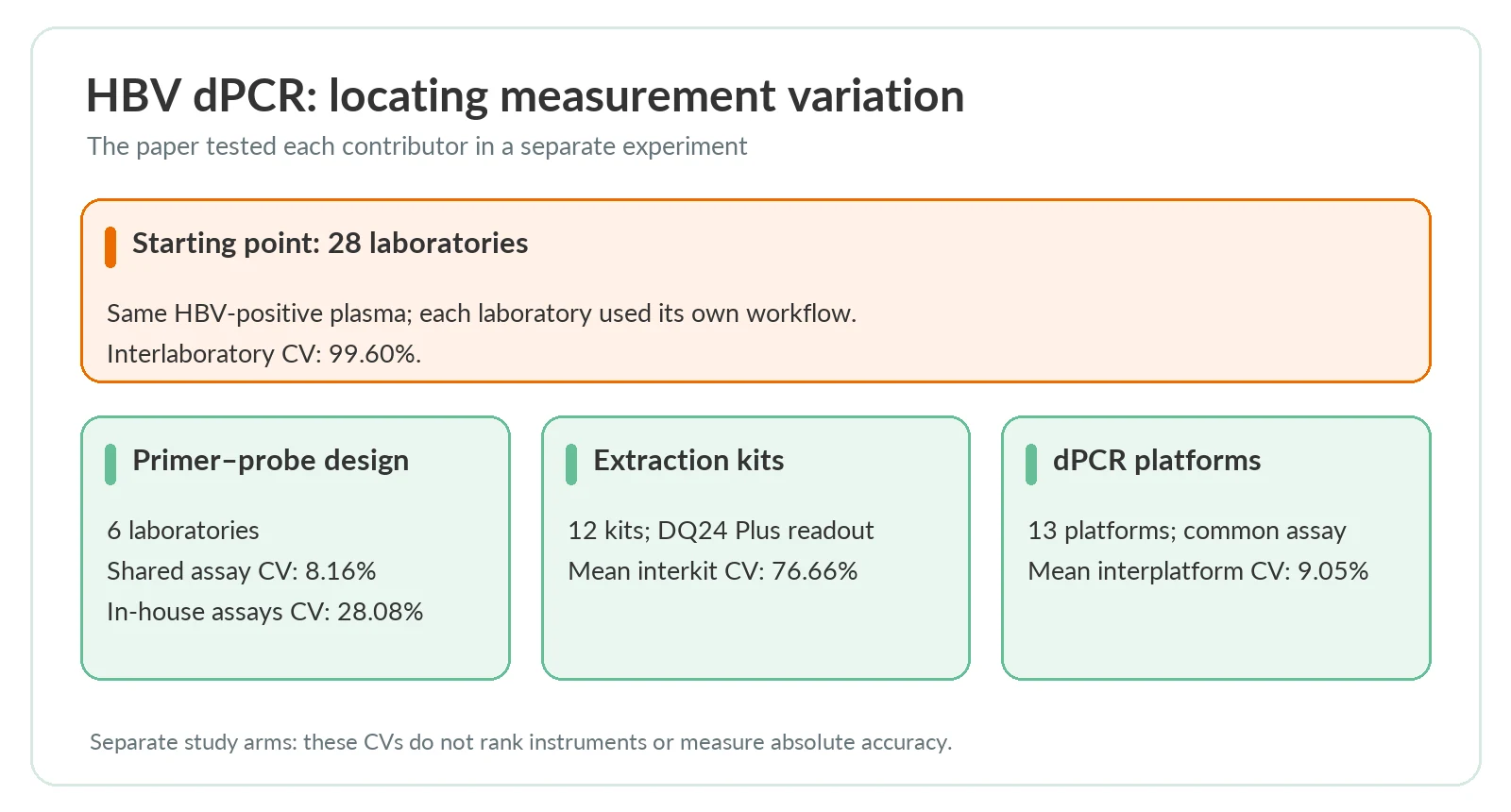
Original summary of separate experiments reported by Ma et al.; CVs are not a product ranking.
Across 12 extraction kits, measured concentrations differed markedly (mean interkit CV 76.66%). The team used a Sniper DQ24 Plus system to read these extracted samples. In a six-laboratory assay-design comparison, a centrally supplied primer–probe set produced 8.16% CV versus 28.08% for in-house designs. With a common assay and HBV genomic DNA, 13 anonymised dPCR platforms showed 9.05% mean interplatform CV.
These are different experimental comparisons, not a single trial in which every variable was changed independently under identical conditions. A CV describes how dispersed the results are; it does not say which result is closest to the true concentration.
The 28-laboratory exercise therefore establishes a reproducibility problem, while the controlled arms help locate plausible contributors.
The large kit-to-kit spread is especially relevant to a plasma reference material because the measurand must first be recovered from a biological matrix. These findings direct attention to sample preparation and assay design when reported HBV concentrations disagree.
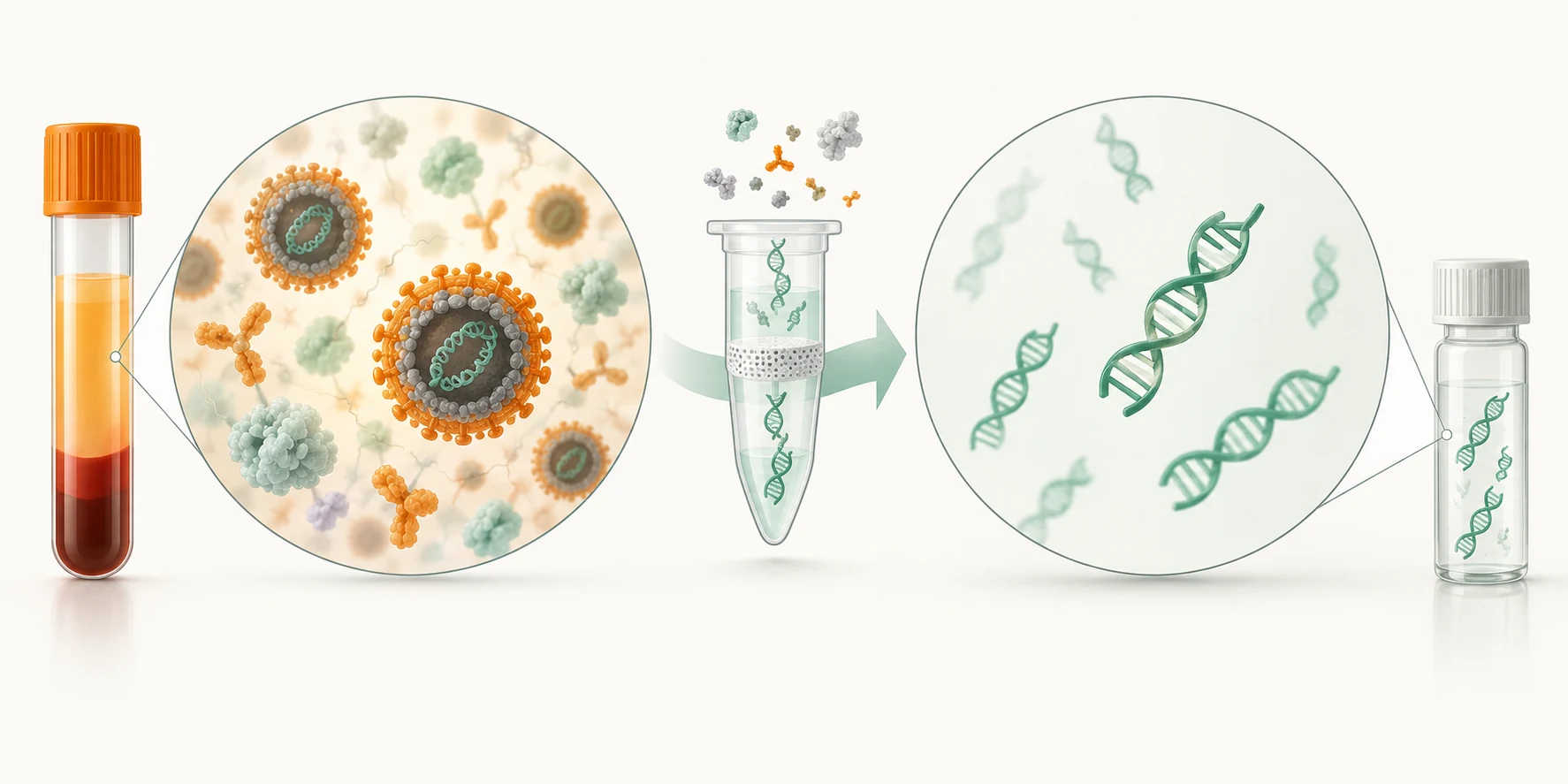
Conceptual illustration of plasma versus extracted DNA; not experimental data.
What is useful for researchers?
For plasma-derived reference materials, document the extraction method and check recovery before attributing a discrepancy to the dPCR instrument. Confirm that primer and probe binding sites suit the intended HBV material. When comparing laboratories, distinguish a measurement starting with plasma from one starting with purified DNA: only the former includes extraction losses.
The study does not show which dPCR instrument is best; platforms were anonymised. The authors also note that the common assay was not optimised for every platform, extraction controls were absent across kits, and independent proof of absolute accuracy remains limited. The practical lesson is to validate the whole measurement chain when a copy number will serve as a reference value.
Publication: Ma N, et al. Critical Factors Affecting Digital PCR Quantification Accuracy in HBV DNA Reference Material for In Vitro Diagnostics. Analytical Chemistry. 2025;97:22490–22496. doi:10.1021/acs.analchem.5c03430.
Topics: #HepatitisB #HBVDNA #DigitalPCR #ReferenceMaterials #AssayValidation