A western blot target band is often divided by a reference signal to account for loading and transfer differences. If that reference varies between samples or saturates as loading increases, the ratio can misrepresent the protein of interest. Westerberg and colleagues tested this problem in primary mature human adipocytes, using GLUT4 as their example target.
First, check what enters the lane
The researchers found that bovine serum albumin (BSA) used during adipocyte isolation could carry into the lysate. It affected bulk protein measurements and the total-protein lane signal, so the main comparisons used BSA-free preparations. Total-protein normalisation depends on measuring the sample’s own protein, not contamination from preparation.
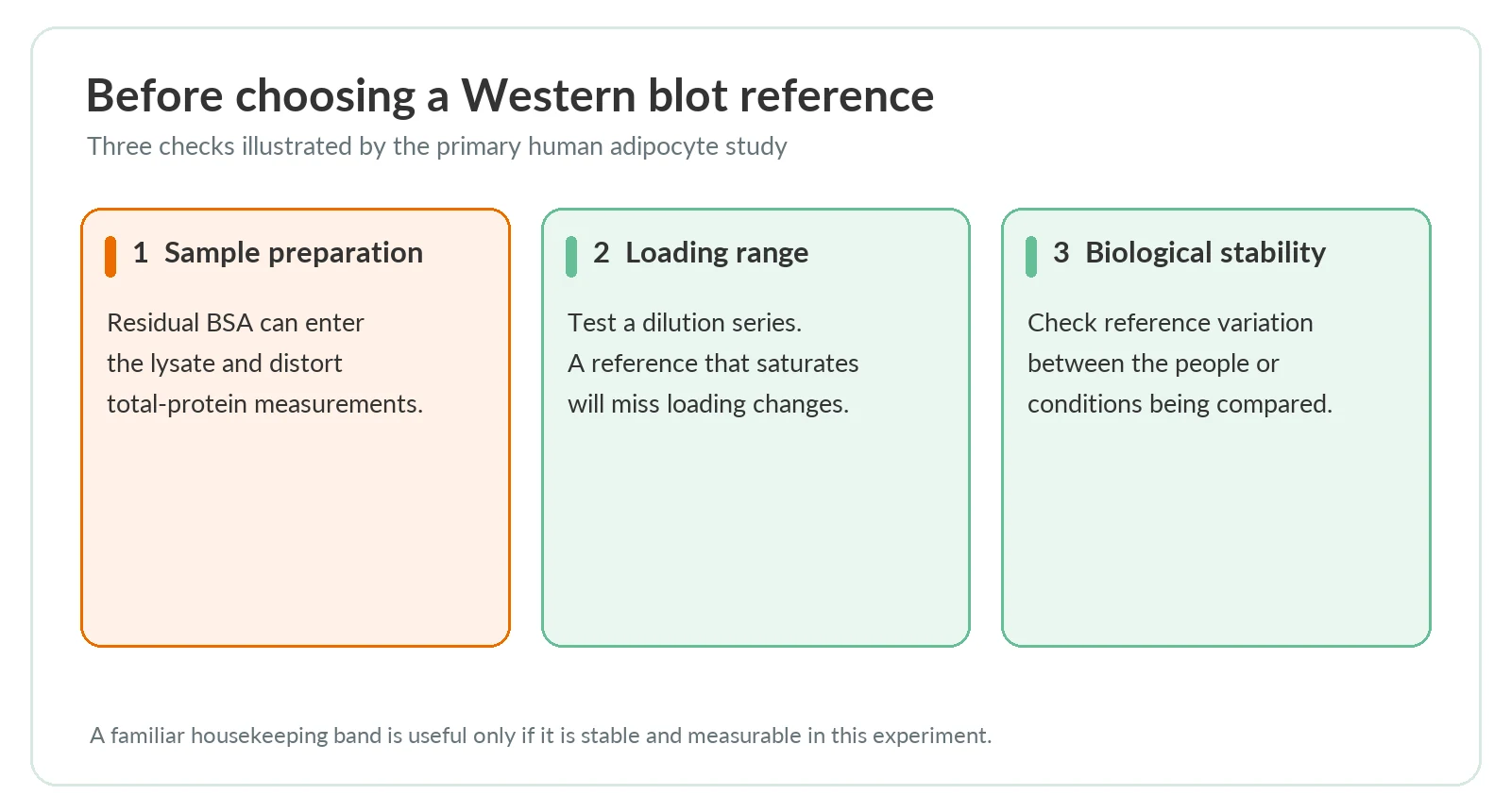
Original checklist based on the study; not a reproduction of its figures.
Which reference was more stable?
The team compared total-protein signal with housekeeping proteins including GAPDH, actin, and tubulin. Across technical replicates from four adipocyte samples, total protein generally showed less variation. In a 2.5–20 µg loading series, it also tracked increasing load more consistently. One candidate housekeeping protein, FAH, saturated over part of that range: a band can appear stable simply because it has stopped responding to additional protein.
In a comparison involving three metabolically similar individuals, the choice of reference altered the apparent between-person pattern of GLUT4. Total protein was relatively stable; actin performed better than several other single-protein references in this part of the study.
That distinction matters: a reference may look stable across repeated lanes of one lysate yet change biologically between people.
The study also found that normalising GLUT4 did not always reduce its variation. Dividing by a noisy reference can add uncertainty, while a saturated reference may hide loading errors. A low-variance band is therefore useful only after its dynamic range and biological stability are checked.
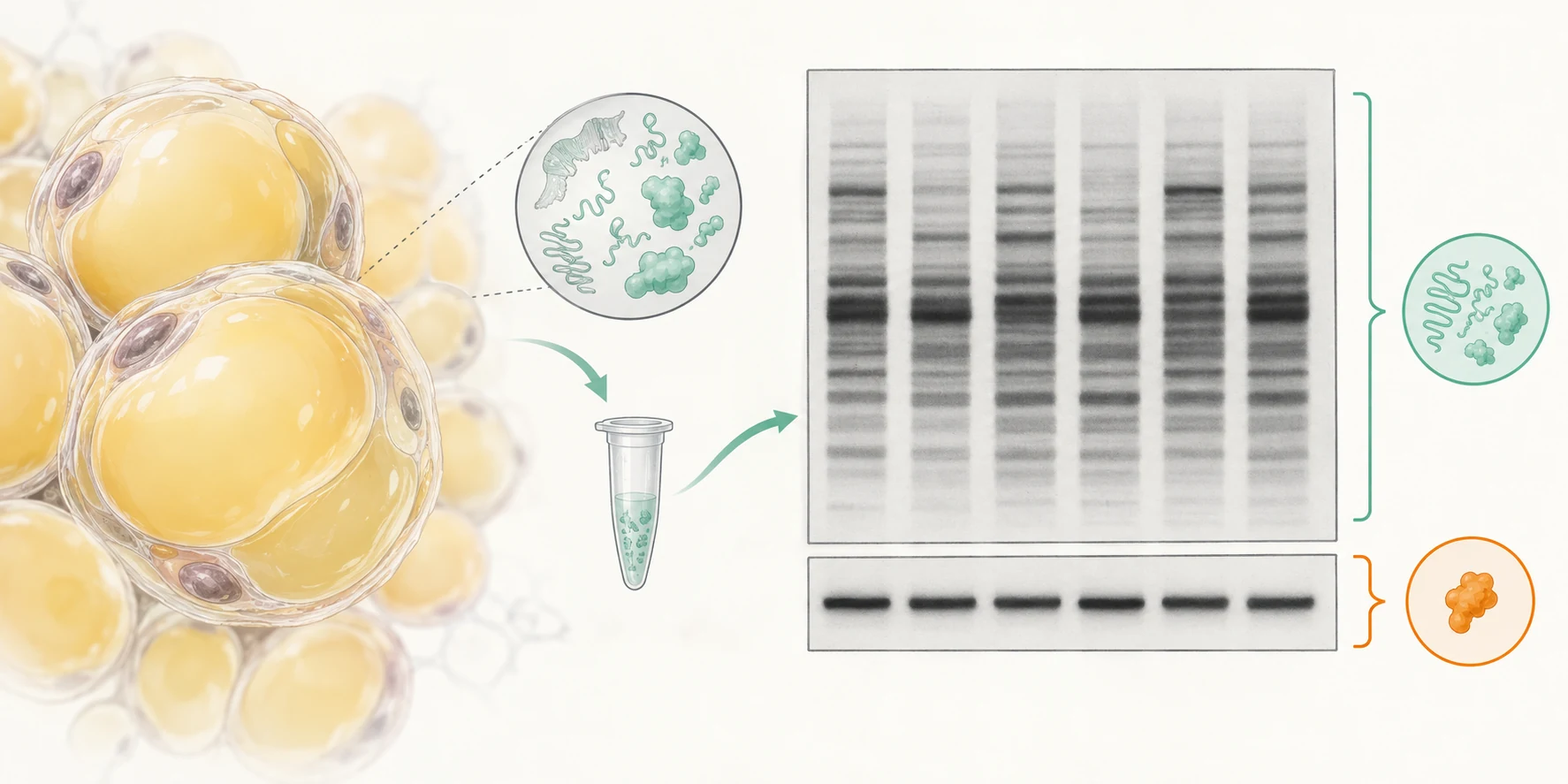
Conceptual blot illustration; the bands are not experimental data.
Research takeaway
A familiar housekeeping protein is not automatically a reliable denominator. Test candidate references across technical replicates, a loading series, and the biological conditions under study. Inspect preparation for exogenous protein before choosing total-protein normalisation. The paper supports total protein for the adipocytes and workflow tested; other tissues and protocols still need their own validation.
Publication: Westerberg LJS, et al. Superior normalization using total protein for western blot analysis of human adipocytes. PLOS ONE. 2025;20:e0328136. doi:10.1371/journal.pone.0328136. CC BY.
Topics: #WesternBlot #Adipocytes #ProteinNormalization #TotalProtein