
1. The timing puzzle
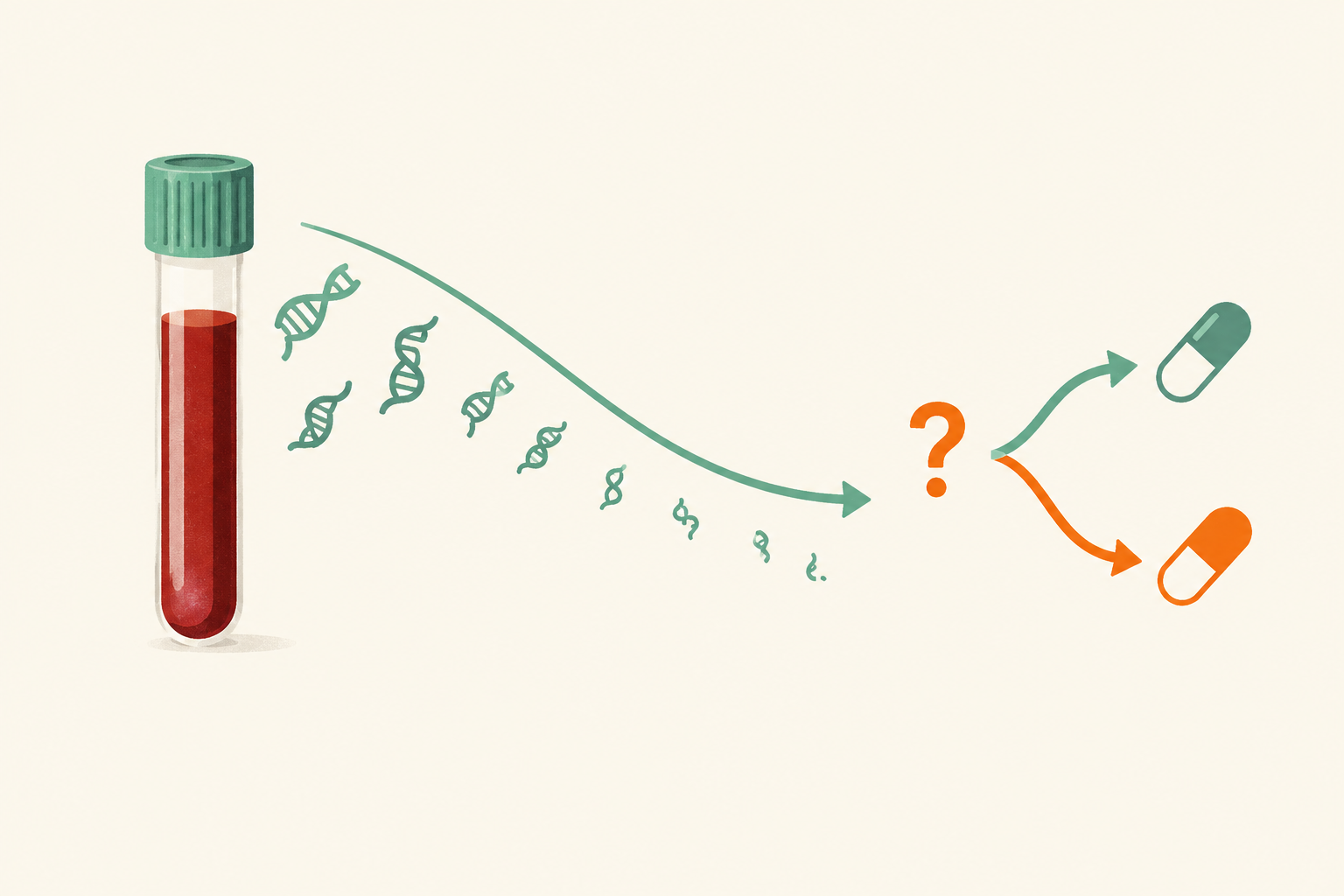
Targeted therapy can quickly reduce BRAF-mutant melanoma, but resistance may develop. Could a blood test identify when a tumour has responded enough to switch to immunotherapy, before that response is lost? The CAcTUS trial tested whether such a decision could be made in real time. Its main question was feasibility, not whether the strategy helps patients live longer (1).
2. How the trial tested the switch
Across 12 UK centres, researchers randomised 21 adults with advanced, BRAF V600-mutant cutaneous melanoma: 10 to a control arm and 11 to a blood-test-guided arm. Control-arm clinicians chose which treatment to give first—targeted therapy or immunotherapy—and switched on progression. Everyone in the guided arm began targeted therapy. Blood was sampled every two weeks initially, then every four weeks; an at-least-80% fall from baseline in the blood’s BRAF variant allele frequency triggered a planned switch to immunotherapy (1).
The test measured the proportion of sampled cell-free DNA carrying the tumour-associated BRAF mutation. Entry required enough of that signal at baseline to measure a fall reliably. Imaging assessed tumour response separately; a blood result was not treated as a substitute for a scan (1).
3. What the blood results established
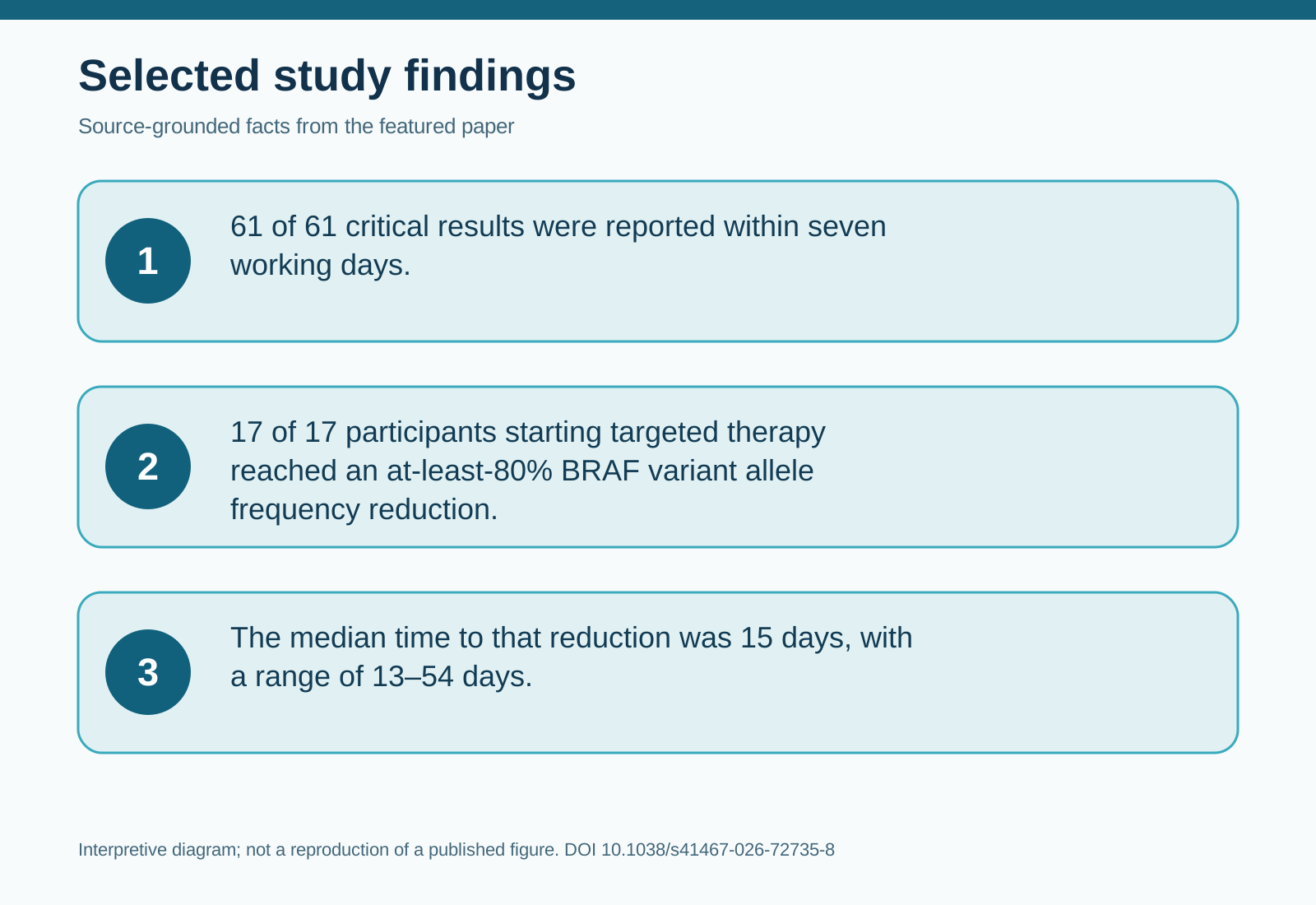
All 61 blood results designated critical for decisions were reported within seven working days, exceeding the trial’s 95% feasibility target. That demonstrates timely reporting in these centres, not that every clinic could reproduce it (1).
All 17 participants who started targeted therapy, across both arms, reached the 80% blood-signal reduction threshold. The median time was 15 days, with a range of 13–54 days. This supports the threshold as an achievable trigger in the selected participants; it cannot establish that switching at that trigger improves survival (1).
4. What happened after switching?
Nine of 11 people in the guided arm switched to immunotherapy after the specified fall. Of those nine, two had a durable immunotherapy response, while six later progressed on immunotherapy and returned to targeted therapy; one died from COVID-19 while responding. The authors also observed rising tumour DNA in immunotherapy nonresponders and responses when evaluable patients restarted targeted therapy. These observations suggest blood monitoring may flag changing disease activity, but they do not show that acting earlier improves outcomes (1).
Median overall survival was 605 days in the control arm and 511 days in the guided arm; the difference was not statistically significant. Grade 3 or 4 treatment-related toxicity occurred in 4 of 10 control participants and 9 of 11 guided participants. Neither comparison establishes which sequence is better or safer (1).
5. Interpretation and Limitations
The authors infer that a blood-guided switch is deliverable and may help locate a useful treatment window. More cautiously, this trial establishes a workable decision process, not a clinical advantage. Recruitment stopped at 21 rather than the planned 40 participants after feasibility targets were met. The baseline blood-signal requirement selected patients with measurable circulating tumour DNA, limiting generalisability. Control-arm treatment order varied, exploratory biomarker analyses were small, and the study was not powered to compare survival or toxicity reliably (1).
6. Takeaway
A rapid blood result can inform a planned switch in this setting. The next question is whether using that result improves outcomes enough to justify the strategy’s risks (1).
7. References
(1) Lee RJ, Rothwell DG, Smith N, Chow S, Delgado-SanMartin J, Mistry H, Sylvestre Y, Chiang SC, Clarke H, Gremel G, Gupta A, Hockenhull K, Kelso N, Kochhar R, Mullan D, Plummer R, Serra P, Shaw H, Summersgill H, Turajlic S, Mouliere F, Marais R, Dive C, Lorigan P. Use of circulating tumour DNA to prospectively guide a switch from targeted to immune therapy in BRAF mutant advanced melanoma: the randomised phase II CAcTUS trial. Nature communications. 2026;17:6850. doi:10.1038/s41467-026-72735-8.
8. Topics
#Melanoma #CirculatingTumourDNA #BRAF #Immunotherapy