1. When a number needs a common language
A molecular result can look reassuringly precise: a number, a decimal point, perhaps a downward trend. The harder question is whether another laboratory would give that number the same meaning. In chronic myeloid leukaemia (CML), that question matters because laboratories follow BCR::ABL1 RNA over time as a marker of residual disease. A shared reference offers a useful starting point for investigating measurement differences before interpreting a changing result. [2]
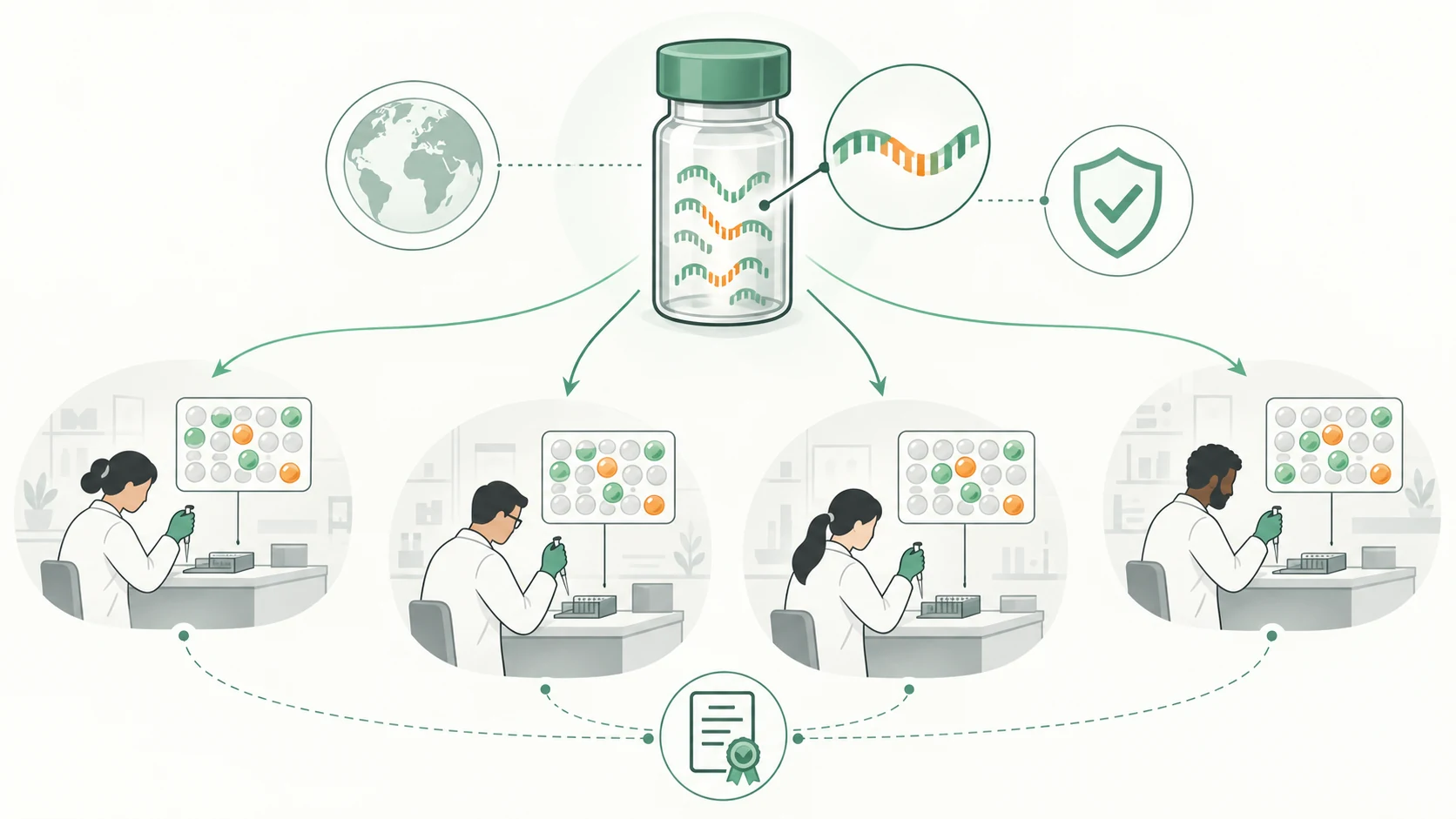
Yang and colleagues focused on that starting point. They developed an RNA reference material containing BCR::ABL1 p210 and characterised it using one-step reverse-transcription digital PCR (RT-dPCR). Their paper asks a measurement question: can a defined material help laboratories check consistency? [1]
2. Why RNA makes the problem more interesting
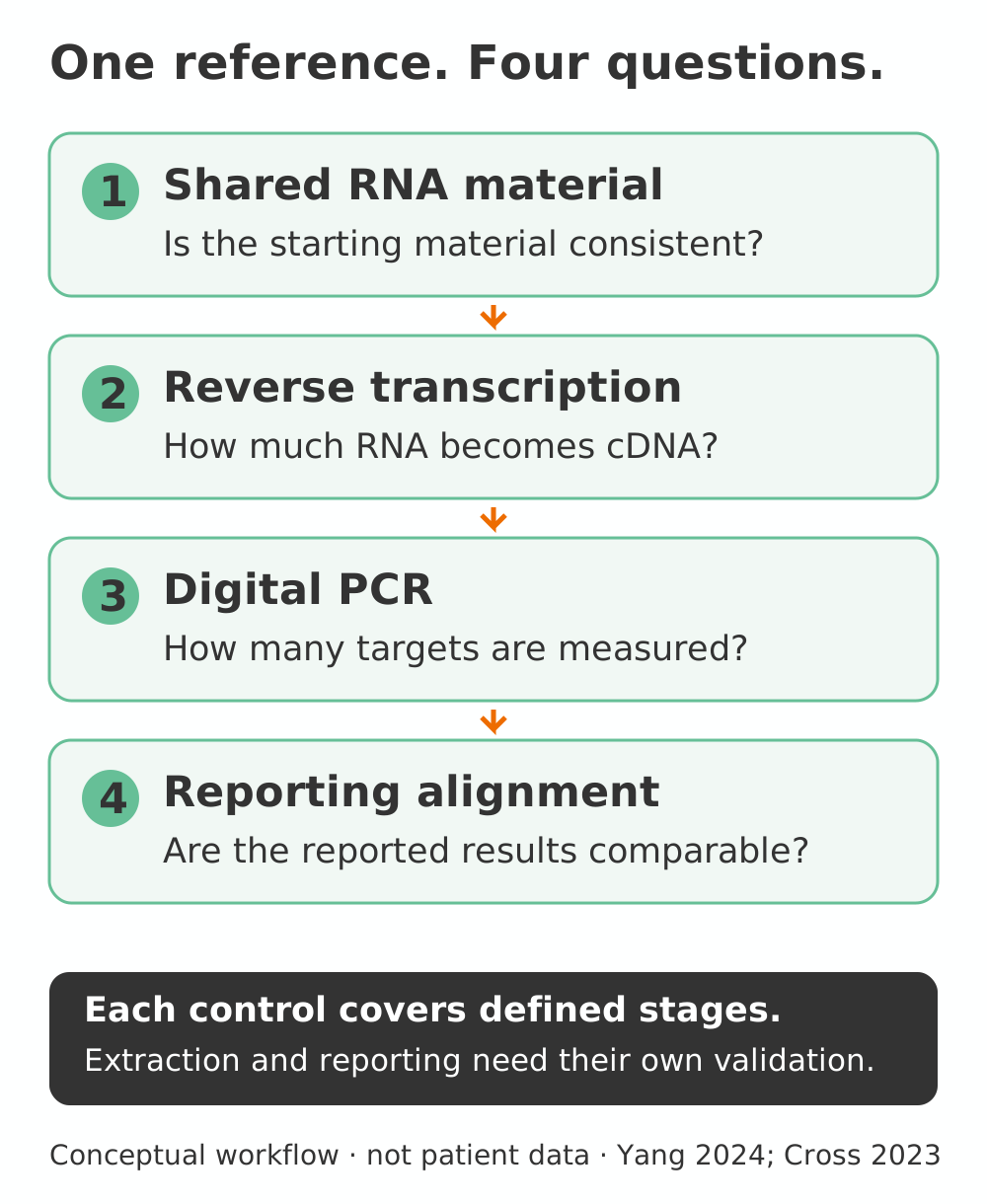
Digital PCR divides a sample into many reactions, identifies positive partitions and estimates target concentration. For RNA, there is an earlier conversion to complementary DNA. Better counting downstream cannot recover molecules that were never successfully converted upstream.
Schwaber and colleagues illustrate why this matters: reverse-transcription efficiency and variability can depend on the transcript and experimental conditions. Their work supports testing RNA standards across relevant concentrations instead of assuming that a precise PCR readout describes the entire RNA workflow. [3]
Think of it as checking both the translator and the tally. An RNA reference challenges the conversion and amplification stages together. A DNA-only control enters further downstream. Each control answers a useful question, but the questions differ. This is a practical interpretation of where a control enters the workflow, rather than a claim that either control solves every source of error.
3. What Yang’s team actually established
The evaluated targets were b2a2 and b3a2 BCR::ABL1 p210 transcripts, plus an ABL1 reference target. These older transcript names correspond to e13a2 and e14a2. Across 10–10,000 copies per reaction, measured concentrations tracked nominal values closely: reported slopes lay between 0.94 and 1.04, with R² at least 0.99. [1,2]
The material was reported homogeneous and stable for 24 months at −80 °C. In an eight-laboratory exercise, coefficients of variation were below 2% for b3a2, the ABL1 reference target and their ratio. Those findings concern the material and conditions studied. [1]
The useful interpretation is that a common starting material can make a comparison easier to interrogate. If laboratories disagree on the same reference, investigating analytical differences becomes more focused. Agreement on that reference, however, cannot by itself establish agreement on every patient sample.
4. Precision, comparability and the reporting scale
A small coefficient of variation answers a repeatability or reproducibility question. It does not automatically answer whether a result is clinically aligned to the reporting system used for CML monitoring. These are separate checks, and keeping them separate prevents an attractive analytical figure from carrying more meaning than the experiment supports.
The 2025 European LeukemiaNet recommendations retain International Scale reporting for standard BCR::ABL1 transcripts. They accept RT-dPCR as an alternative to RT-qPCR and require local validation of methods used clinically. Reference genes and an appropriate route to scale alignment remain part of the measurement system. [4]
That distinction helps place this paper: the reference material may support traceability and quality control, while a laboratory must still establish how its own reported results relate to the International Scale. A copy concentration and an International Scale percentage are different quantities. [1,4]
5. How a laboratory might use the idea
One practical use would be a planned comparison before and after an assay change. The laboratory could measure the same reference aliquots alongside its existing controls, document the expected behaviour, then examine whether a new reagent lot or workflow introduces a shift. This is a proposed quality-control application, not an intervention tested in patients by Yang’s team.
A second question is where the reference enters. Adding purified RNA after extraction cannot test how efficiently RNA was recovered from the original clinical specimen. Recording that entry point makes the control’s coverage explicit. It also helps avoid treating a passing downstream control as proof that every earlier step worked.
A third question is concentration. Agreement in a comfortable measurement range should prompt a separate assessment near the laboratory’s intended low-level reporting range. The most informative next experiment may be the one that tests where confidence starts to weaken. These are implementation questions for local validation, rather than performance claims for this material.
6. What remains unresolved
The available study summary does not establish clinical outcomes, patient-sample interchangeability, or the safety of changing treatment decisions. Its tested concentration range also should not be read as proof of performance below that range. The reference offers evidence about a measurement system; broader claims need broader experiments.
European LeukemiaNet laboratory guidance also stresses RNA quality, reference-transcript measurements and appropriate interpretation when BCR::ABL1 is not detected. A negative target signal needs adequate sample-level evidence before it can support a statement about measurement sensitivity. [2]
The interesting next question is therefore how well a laboratory’s controls reflect the samples it actually receives. Transport, extraction, RNA integrity and reverse transcription deserve their own checks. A shared reference can be one part of that assessment, with its role defined rather than assumed.
7. The takeaway
This study’s appeal is the possibility of giving different laboratories a common analytical starting point. That makes disagreements easier to investigate and confidence easier to explain. The practical lesson is to ask what each control covers, what it leaves untested, and how the final result acquires its reporting meaning. Good counting becomes more useful when the whole measurement chain is understood.
8. References
[1] Yang Y, Wang X, Niu C, et al. Establishment of genomic RNA reference materials for BCR-ABL1 P210 measurement. Analytical and Bioanalytical Chemistry. 2024;416:5733–5742. doi:10.1007/s00216-024-05492-6.
[2] Cross NCP, Ernst T, Branford S, et al. European LeukemiaNet laboratory recommendations for the diagnosis and management of chronic myeloid leukemia. Leukemia. 2023;37:2150–2167. doi:10.1038/s41375-023-02048-y.
[3] Schwaber J, Andersen S, Nielsen L. Shedding light: The importance of reverse transcription efficiency standards in data interpretation. Biomolecular Detection and Quantification. 2019;17:100077. doi:10.1016/j.bdq.2018.12.002.
[4] Apperley JF, et al. 2025 European LeukemiaNet recommendations for the management of chronic myeloid leukemia. Leukemia. 2025. doi:10.1038/s41375-025-02664-w.
9. Topics
#CML #BCRABL1 #RNAReferenceMaterials #DigitalPCR #MolecularMonitoring #LaboratoryQuality #MetrologicalTraceability