Monitoring chronic myeloid leukaemia (CML) often involves measuring the BCR::ABL1 p210 fusion transcript relative to a reference transcript. A result is most useful when laboratories can compare measurements made at different times and sites. Yang and colleagues investigated a genomic RNA reference material carrying BCR::ABL1 p210 and used one-step reverse-transcription digital PCR (RT-dPCR) to assign and check its values. This was a measurement study, not a trial of treatment decisions.
Why an RNA reference matters
Digital PCR counts target molecules through partitioning without a conventional external calibration curve. For an RNA target, however, reverse transcription must happen before amplification, and RNA preparation and storage can affect what is measured. A common RNA material gives laboratories something defined to test their methods against. It does not remove the need to check their own sample and assay workflows.
What the researchers tested
The team measured the b2a2 and b3a2 BCR::ABL1 p210 transcripts and an ABL1 reference target. From 10 to 10,000 copies per reaction, measured and nominal values showed near-proportional relationships: slopes were 0.94–1.04, with R² at least 0.99. These results describe the evaluated material and method over that range; they do not establish performance at every lower transcript concentration.
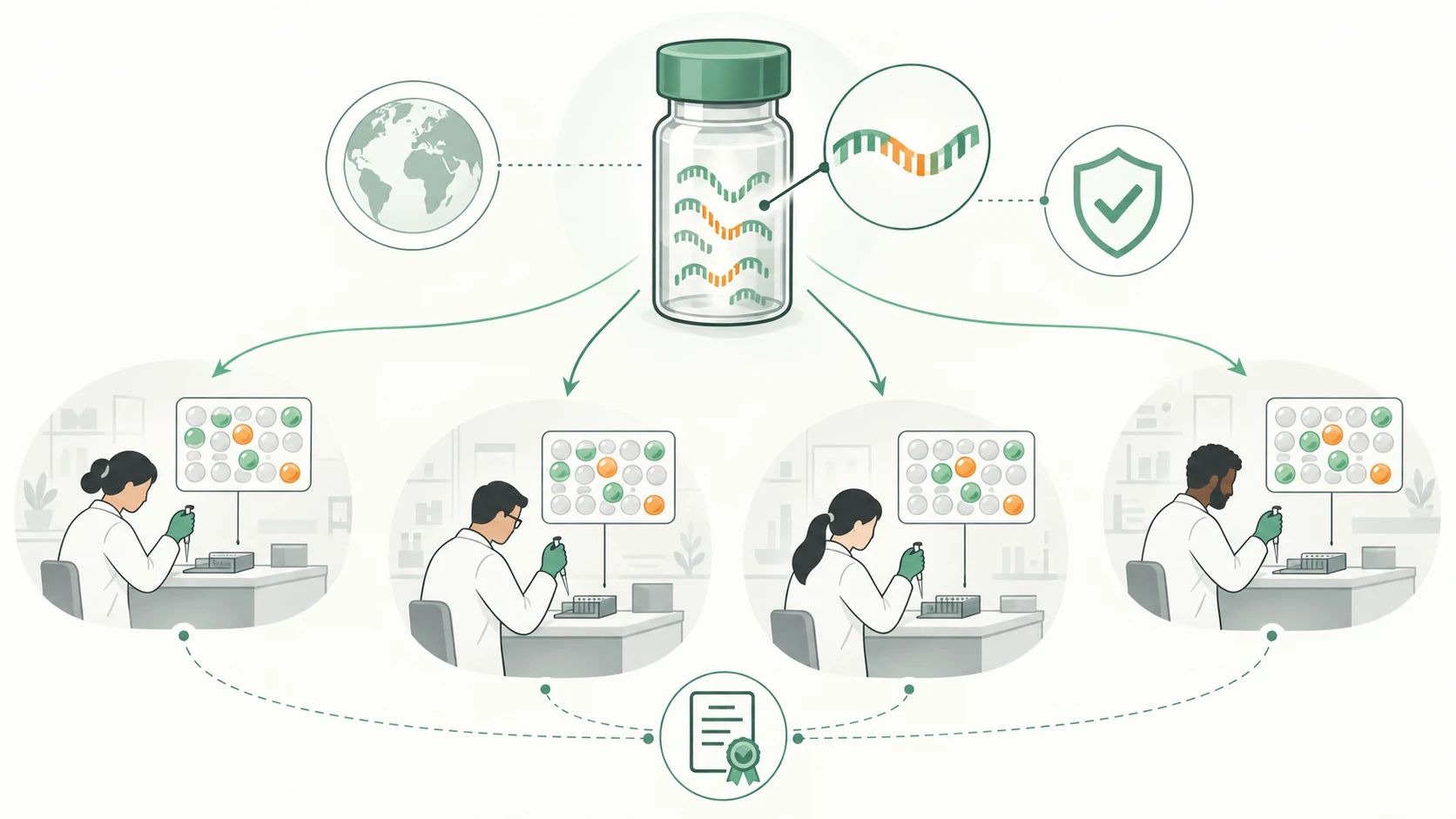
Original conceptual illustration of a shared RNA material and multiple laboratories; not study data.
The authors found the material homogeneous and stable for 24 months at −80 °C. In an eight-laboratory assessment, the reported coefficients of variation were below 2% for b3a2, ABL1 and their ratio. That is useful evidence for the material’s consistency in this exercise. It is not a head-to-head ranking of instruments or a measure of agreement in patient samples.
What this changes for a laboratory
An RNA reference material can help a laboratory check whether its BCR::ABL1 measurements remain comparable across runs and sites. Before applying it to routine monitoring, the laboratory still needs to validate its extraction and reverse-transcription steps, assay range, controls and reporting alignment. The study supports the material’s potential role in traceability and quality control; it did not test whether changing platforms improves clinical outcomes or makes treatment discontinuation safer.
Publication: Yang Y, et al. Establishment of genomic RNA reference materials for BCR-ABL1 P210 measurement. Analytical and Bioanalytical Chemistry. 2024;416:5733–5742. doi:10.1007/s00216-024-05492-6.